

What to Look for in a Custom Hotel Furniture Manufacturer
A sourcing decision that covers 30–400+ rooms and carries lead times of 60–120 days demands more than a catalog browse. This guide breaks down the 6 measurable criteria that separate capable manufacturers from ones that create costly project delays.
- 🏗 Custom vs Off-the-Shelf: The Cost Logic
- 📋 6 Criteria for Evaluating a Custom Hotel Furniture Manufacturer
- 🏅 Certifications That Carry Weight
- ⏱ Lead Time & MOQ Benchmarks
- Lead Time Risk Factors
- 🪵 Material Grade Comparison
- 🚩 Red Flags & Procurement Checklist
- Red Flags — Disengage if You See These
- Procurement Checklist — Before Issuing a PO
- ❓ Frequently Asked Questions
A hotel renovation or new build typically requires furniture across 6–12 distinct zones — guest rooms, lobby, restaurant, conference rooms, corridors, spa, and pool area. Each zone has different load requirements, material specifications, and aesthetic standards. An off-the-shelf supplier can cover roughly 40–60% of these needs; a capable custom manufacturer can cover 100%, from a single factory with traceable production records. The distinction matters most when a project requires ISO-certified materials for franchise compliance, or when the design brief calls for non-standard dimensions that catalog furniture cannot accommodate. Hotel furniture wholesale orders — typically 100+ units per SKU — sit in the middle ground: a custom manufacturer handles this volume with full specification control, while a catalog distributor fulfills the quantity but cannot adjust materials or dimensions.
This guide is structured as a buying framework, not a promotional piece. Every data point is sourced from published industry standards (ISO, EN, ASTM) or from documented manufacturer specifications.
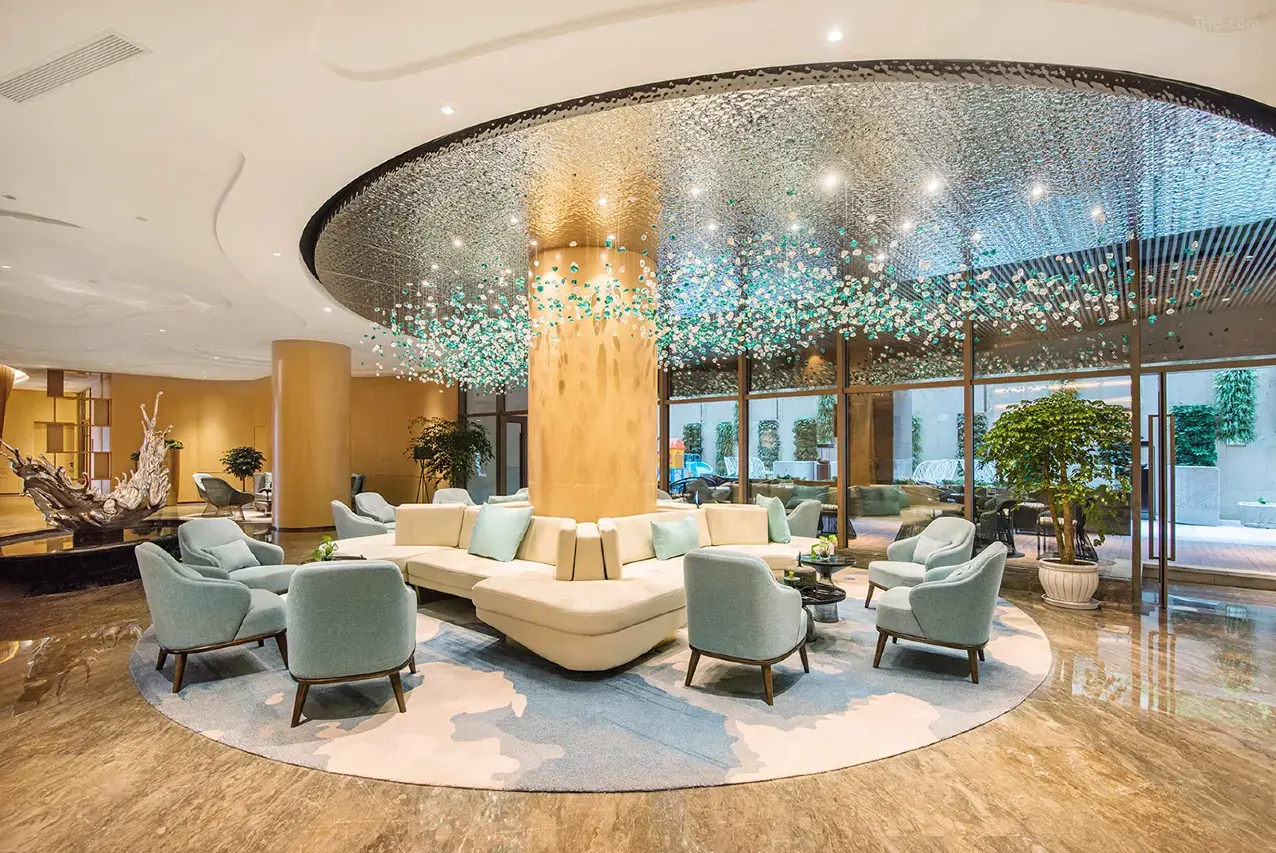
🏗 Custom vs Off-the-Shelf: The Cost Logic
The choice between custom and catalog furniture is primarily a unit-economics calculation, not a design preference. For a hotel project with more than 80 rooms, custom manufacturing typically reaches cost parity with premium catalog brands at quantities above 100 units per SKU, because per-unit tooling costs amortize to under $8–15 per piece at that volume.
| Dimension | Off-the-shelf catalog | Custom manufacturer |
|---|---|---|
| Lead time | 2–6 weeks (from stock) | 45–120 days (from approval) |
| MOQ | 1 unit | Typically 30–100 units/SKU |
| Dimension flexibility | Fixed catalog sizes | ±5 mm tolerance on custom specs |
| Material certification | Varies; often unstated | Specifiable per ISO/EN standard |
| Franchise brand compliance | Rarely compatible | Built to FF&E design intent |
| Per-unit cost at 200 rooms | $180–$350 (mid-grade) | $140–$320 (equivalent grade) |
| Replacement sourcing (5 yr) | Risk of discontinuation | Exact re-order from same specs |
The operational argument for custom is durability accountability. When a guest room chair fails at 40,000 cycles instead of the specified 100,000 (per EN 16139:2013 contract seating standard), a custom order with documented test records creates a recoverable warranty claim. Catalog furniture rarely provides test cycle data per unit.
📋 6 Criteria for Evaluating a Custom Hotel Furniture Manufacturer
These criteria are designed to be answered with documentation, not with verbal assurances during a factory visit or sales call. Request evidence for each before signing a Letter of Intent.
-
Production capacity (units/month, not floor area)A factory's floor area is a poor proxy for output. Ask for monthly production capacity by product category — panel furniture, upholstery, solid wood, metalwork — expressed in units. A facility producing 3,000 panel units/month can fulfill a 600-room project in roughly 60–75 days; a 500-unit/month facility requires 5–6 months for the same scope, creating project timeline risk.
-
CNC equipment count and generationCNC panel saws and routing centers determine dimensional accuracy. Ask for the equipment list: model, year, and tolerance spec. Third-generation CNC centers (post-2015) typically hold ±0.1 mm dimensional tolerance; older equipment drifts to ±0.5 mm, which compounds across multi-piece assemblies. For hotel room furniture requiring built-in fit (wardrobes, headboard panels), tolerance matters.
-
In-house finishing vs subcontractedLacquer painting, PU finishing, and veneer application are common subcontracting points. Each handoff adds 5–12 days of lead time and introduces one additional quality inspection gap. Ask whether finishing is in-house; request the production flow chart showing which operations leave the factory.
-
Material traceability documentationFor formaldehyde-sensitive markets (EU, US, Australia), the board supplier's CARB Phase 2 or E1/ENF certificates must accompany the production batch. A manufacturer who cannot provide the chain of supply from board supplier → cutting → assembly → finish has no traceable formaldehyde compliance. CARB Phase 2 limits hardwood plywood to ≤0.05 ppm; E1 limits particleboard to ≤0.1 mg/m³ (ISO 16000-3 test method).
-
Sample production capabilityAny manufacturer capable of handling a 100+ room project should produce a full-size prototype of each SKU within 15–25 days of design approval. If the factory cannot produce samples that fast, it signals insufficient production planning capacity. Inspect samples for: corner joint integrity, edge banding adhesion (peel test at 45°), drawer slide cycle count (minimum 50,000 BHMA A156.9 cycles), and finish uniformity under 4,000K lighting.
-
Post-delivery installation recordInstallation is not furniture manufacturing, but it directly determines the final quality outcome. Ask for case references where the manufacturer handled delivery + installation, not just FOB handover. A manufacturer managing both typically reduces on-site installation defect rates by 15–25% compared to third-party installation teams working from product documentation alone.
🏅 Certifications That Carry Weight
Not all certifications on a supplier's website are equally meaningful for hotel procurement. The list below distinguishes structural quality certifications from marketing-tier awards.
| Standard | What it covers | Why it matters for hotel buyers | Status |
|---|---|---|---|
| ISO 9001:2015 | Quality management system — process control, traceability, corrective actions | Confirms the factory has documented procedures for rejecting non-conforming goods; minimum requirement for franchise-flag compliance | Essential |
| ISO 14001:2015 | Environmental management — waste, emissions, material sourcing | Required by EU Green Deal–aligned brands (Accor, IHG) for FF&E procurement; covers material sourcing audits | Required (EU flags) |
| EN 16139:2013 | Contract seating — structural durability cycle test (100,000 cycles for Level 2) | Sets minimum cycle-load spec for lobby chairs and restaurant seating; without this test, there's no documented durability baseline | Essential (seating) |
| CARB Phase 2 | Formaldehyde emissions limit — hardwood plywood ≤0.05 ppm | Mandatory for US market; hotels exporting to California face liability without supplier compliance documentation | Mandatory (US) |
| ENF Grade (ISO 16000-3) | Formaldehyde ≤0.025 mg/m³ — stricter than E1's 0.1 mg/m³ | EU REACH and indoor air quality regulations increasingly cite ENF thresholds; future-proofs EU supply chains | Recommended (EU) |
| ASTM F1561 | Commercial-grade outdoor furniture — structural load and corrosion resistance | Applicable to pool-area and terrace furniture; specifies salt-spray and UV resistance test periods | Applicable (outdoor) |
| SGS / BV inspection | Third-party pre-shipment inspection | Provides buyer-side QC without factory visit; typically covers AQL 2.5 sampling, dimension check, finish audit | Best practice |
⏱ Lead Time & MOQ Benchmarks
Lead time and MOQ are the two figures most commonly misrepresented during initial sales conversations. The table below shows realistic ranges segmented by project scale, based on standard manufacturing workflow timelines.
| Project scope | Typical MOQ | Sample delivery | Production lead time | Total timeline (incl. shipping) |
|---|---|---|---|---|
| 30–80 rooms | 30–50 units/SKU | 15–20 days | 35–50 days | 65–90 days (sea freight) |
| 80–200 rooms | 50–100 units/SKU | 18–25 days | 45–70 days | 75–110 days |
| 200–500 rooms | 100+ units/SKU | 20–30 days | 60–90 days | 90–130 days |
| 500+ rooms (phased) | Negotiable per phase | 25–35 days | 90–120 days/phase | Phased delivery schedule |
for an 80–200 room project
for cost-effective custom production
Lead Time Risk Factors
Three factors consistently extend lead times beyond the estimates above:
- Late design approval — each revision cycle after production start adds 5–10 days. Lock final drawings before placing the production deposit.
- Material sourcing delays — specialty veneers, custom hardware, and imported fabrics (e.g., Italian leather panels) require 15–30 days procurement lead time before cutting begins.
- Port congestion — South China ports (Guangzhou, Shenzhen) experience 5–15 day backlogs during Q4 (October–December). Projects with Q1 hotel openings should ship by end of September.
🪵 Material Grade Comparison
Material selection controls durability, indoor air quality, and cost simultaneously. The table below maps common hotel furniture substrates against their structural rating, formaldehyde compliance, and appropriate application zones.
| Material | Bending strength | Formaldehyde class |
|---|---|---|
| Solid hardwood (oak/walnut/teak) | 80–120 MPa | N/A (natural) |
| Hardwood plywood (CARB P2 / ENF) | 35–60 MPa | ≤0.05 ppm (CARB P2) |
| MDF E1 grade | 25–40 MPa | ≤0.1 mg/m³ (ISO 16000) |
| MDF ENF grade | 25–40 MPa | ≤0.025 mg/m³ |
| Moisture-resistant MDF (MR-MDF) | 28–42 MPa | Varies by binder |
| Aluminum profile (alloy 6063) | 160–270 MPa | N/A |
🚩 Red Flags & Procurement Checklist
Red Flags — Disengage if You See These
❌ Cannot provide ISO 9001 certificate with expiry date — no auditable quality system; claims are unverifiable.
❌ Lead time quote under 30 days for a 100+ room order — either stock furniture (not custom) or an unrealistic commitment.
❌ Refuses pre-shipment inspection by SGS / Bureau Veritas / Intertek — indicates concern about QC failure under third-party review.
❌ Cannot name board supplier or provide CARB / E1 test report — formaldehyde compliance is unverifiable without material traceability.
❌ No physical factory address verifiable on satellite imagery — possible trading company presenting as manufacturer.
❌ Payment terms: 100% upfront — industry norm for custom orders is 30–40% deposit, balance on pre-shipment inspection pass.
Procurement Checklist — Before Issuing a PO
- ISO 9001:2015 certificate— verify expiry date and certifying body (TÜV, SGS, Bureau Veritas)
- ISO 14001:2015 certificate— required for Marriott, Hilton, Accor flags
- Factory audit report— third-party or brand-authorized auditor within 24 months
- Material test reports— CARB Phase 2 or E1/ENF for all panel substrates used
- EN 16139 test report— for all contract seating items (lobby, restaurant, bar)
- Sample approval sign-off— written approval of physical prototype before production start
- Production schedule— week-by-week Gantt chart tied to delivery milestone
- Pre-shipment inspection clause— named third-party inspector in the contract
- Warranty terms in writing— minimum 12 months structural warranty, specific to defect type
- Re-order policy— confirm ability to reproduce from same material and finish spec within 3 years
- Insurance documentation— marine cargo insurance covering CIF value
❓ Frequently Asked Questions
What is the minimum order quantity for custom hotel furniture from a Chinese manufacturer?
The practical minimum is 30 units per SKU for economically viable custom production. Below 30 units, the per-piece setup cost for CNC programming and finishing line changeover typically exceeds the material savings over catalog alternatives. Some manufacturers accept 10–20 units for add-on orders from existing clients, but not for new SKU tooling.
How do I verify that a Chinese manufacturer's ISO certificates are genuine?
All ISO 9001 and ISO 14001 certificates issued by accredited certification bodies (SGS, TÜV SÜD, Bureau Veritas, Intertek) are searchable through the IAF CertSearch database at certisearch.iaf.nu. Enter the certificate number and issuing body to confirm validity, scope, and expiry date. Certificates that do not appear in this database are either expired or fabricated.
What formaldehyde standard should I specify for a hotel project in the EU?
Specify ENF grade (≤0.025 mg/m³ as measured per ISO 16000-3 or ISO 16000-9) for all interior panel applications. The EU's Construction Products Regulation (CPR) references this threshold, and several major hotel brands including Accor and IHG have incorporated ENF as their minimum material standard in their brand standards documents as of 2024. E1 (≤0.1 mg/m³) remains the legal minimum across EU member states but is no longer sufficient for premium-flag compliance.
What durability test standard applies to hotel lobby seating?
EN 16139:2013 is the applicable standard for contract furniture used in non-domestic environments. Level 2 (severe use) specifies 100,000 cycles under combined seat and backrest load cycling. This is the standard cited in most European hotel brand FF&E specifications. For the US market, BIFMA X5.1:2017 (office chairs) or BIFMA X5.4 (lounge seating) applies depending on the specific product type.
How long should hotel guest room furniture last before replacement?
Industry benchmarks from the American Hotel & Lodging Association (AHLA) cite an 8–12 year replacement cycle for case goods (wardrobes, desks, nightstands) and 5–8 years for upholstered seating in mid-scale and above properties. Furniture built to EN 16139 Level 2 and CARB Phase 2 standards consistently meets the 8-year threshold when maintained per the manufacturer's guidelines. Economy properties operating at higher occupancy rates (75%+) typically see 20–30% shorter replacement cycles.
Is sea freight the standard shipping method for hotel furniture from China?
For full-project orders above 20 CBM, sea freight (LCL or FCL) is the standard method. FCL (Full Container Load) is cost-effective above approximately 15 CBM and provides better damage protection because goods are not co-loaded with unrelated cargo. Transit time from South China ports to European ports is 25–32 days; to US East Coast ports, 28–35 days; to the Middle East (Jebel Ali), 18–22 days. Air freight applies only to samples or urgent replacement pieces under 200 kg.
Selecting the right custom hotel furniture manufacturer is a procurement decision with a 10–15 year operational tail. The criteria in this guide — production capacity, certification status, material traceability, and lead time realism — are measurable at the pre-contract stage. A manufacturer who can answer each of the checklist items above with documentation, not verbal assurance, removes the principal sources of project risk: delayed delivery, non-compliant materials, and unresolvable warranty disputes. For custom made hotel furniture projects above 80 rooms, the investment in due diligence at this stage consistently returns more value than negotiating marginal price reductions on the unit cost.
From Blueprint to Room: A Bespoke Hotel Furniture Case Study
Maintenance and Warranty Guide: Ensuring the Longevity of China Hotel Furniture
Commercial Grade Standards: Materials Used in China Hotel Furniture
Shipping Hotel Furniture from China: Navigating Logistics and Tariffs
A Step-by-Step Guide to Implementing Professional Custom Hotel Furniture Solutions
About Cooperation Process
How to start working with your company?
You can contact us through our official website or contact information, and our sales team will be happy to assist you.
How to sign a cooperation agreement?
We will provide you with a draft cooperation agreement, which will be signed by both parties after confirmation to ensure the legality and standardization of the cooperation process.
About Products and Services
How do you handle international logistics and transportation?
We cooperate with internationally renowned logistic companies to provide a variety of transportation methods such as sea transportation and air transportation. We will choose the most suitable transportation method and route according to customer need and cargo characteristic. At the same time, we will carry out professional packaging protection to ensure that the furniture is not damaged during transportation.
Products
What's your delivery time? We need faster delivery time. Can you meet it?
Our delivery cycle is generally 30-60 days.
The specific delivery time depends on the project volumes and terms. If the delivery time of your products is urgent, we can arrange your production order in advance.
Are you a factory or a trading company? Where is the production base?
We are a company integrating industry and trade. We have a large scale with more than 600 employees and have been deeply involved in the furniture industry for 24 years. We have two production bases, one in Foshan and one in Baiyun, with a factory area of 100,000 square meters.
Get in Touch
We strive to provide the most thoughtful service, excellent quality and value to every customer who customizes hotel furniture from STARJOY. If you have any questions about your order, please contact us.

No.19, Gulou Industrial Zone, Jianggao Town, Baiyun District, Guangzhou
monica@starjoyglobal.com


