

How to ship commercial hotel lobby furniture internationally? | Insights by STARJOY
Procuring commercial hotel lobby furniture internationally requires a deep understanding of shipping methods, costs, documentation, and customs. This guide for custom hotel furniture industry buyers covers essential topics including ocean vs. air freight, cost estimation factors like HS codes and Incoterms, critical customs documentation, robust packaging solutions, the impact of duties and taxes, the role of freight forwarders, and choosing the right Incoterms for efficient global delivery. Master these professional insights to ensure your custom furniture arrives safely and on budget.
- Navigating International Shipping for Commercial Hotel Lobby Furniture
- What are the primary international shipping methods for commercial hotel lobby furniture?
- How can I accurately estimate international shipping costs for hotel furniture?
- What essential documentation is required for international customs clearance?
- How is commercial hotel furniture typically packaged for international transit to prevent damage?
- What should I know about customs duties, taxes, and tariffs for importing hotel furniture?
- Is a freight forwarder necessary, and what are their benefits?
- Which Incoterms® are most suitable for international furniture procurement, and why?
- Why Choose STARJOY for Your Commercial Hotel Lobby Furniture?
Navigating International Shipping for Commercial Hotel Lobby Furniture
Navigating the complexities of international shipping for large, custom commercial hotel lobby furniture can be a daunting task for procurement professionals. From understanding freight options to customs regulations and packaging requirements, each step demands careful attention to ensure your investment arrives safely and on time. This guide breaks down the essential professional knowledge you need to master international furniture logistics.
What are the primary international shipping methods for commercial hotel lobby furniture?
When shipping commercial hotel lobby furniture internationally, two primary methods stand out: ocean freight and air freight. The choice largely depends on factors like shipment volume, urgency, and budget.
- Ocean Freight: This is the most common and cost-effective method for large, heavy, or bulky hotel furniture. It offers two main options:
- Full Container Load (FCL): If your order is large enough to fill an entire shipping container (e.g., a 20-foot or 40-foot standard or high cube container), FCL is ideal. It provides better security, faster transit times compared to LCL, and less handling. A 40-foot High Cube (HC) container, for instance, offers approximately 2,694 cubic feet (76.2 cubic meters) of capacity, suitable for significant hotel projects.
- Less than Container Load (LCL): For smaller orders that don't fill a container, LCL allows your furniture to share container space with other goods. While more economical for smaller volumes, it typically involves more handling, longer transit times due to consolidation/deconsolidation processes, and a higher risk of damage.
Typically, ocean freight from major manufacturing hubs like China to destinations in North America or Europe can take anywhere from 20 to 45 days, depending on the specific route, port congestion, and service type. As of late 2023, average ocean freight rates for a 40' HC container from Shanghai to Los Angeles ranged from approximately $2,000 to $4,000, though these rates are highly volatile and subject to market fluctuations.
- Air Freight: While significantly faster (often 3-10 days transit), air freight is considerably more expensive—sometimes 5 to 10 times the cost of ocean freight for heavy goods. It's usually reserved for urgent shipments, high-value items, or smaller, lighter pieces of furniture where speed is paramount and cost is a secondary concern. Due to size and weight restrictions, it's less practical for entire lobby furniture sets.
How can I accurately estimate international shipping costs for hotel furniture?
Estimating international shipping costs requires a comprehensive approach, as many variables contribute to the final price. Key factors include:
- Volume and Weight: This is the most significant factor. Freight charges are calculated based on either the actual weight or the volumetric weight (chargeable weight), whichever is greater. Large, bulky furniture takes up more space and contributes more to both.
- Origin and Destination: The distance and specific routes between the loading port/airport and the destination port/airport heavily influence the base freight rate.
- Shipping Method: As discussed, ocean freight is cheaper than air freight. FCL is generally more cost-efficient per cubic meter than LCL.
- Incoterms®: The chosen Incoterms (e.g., FOB, CIF, DDP) dictate which party is responsible for specific costs and risks, from factory to final destination. This significantly impacts the price quoted by the supplier or freight forwarder.
- Customs Duties, Taxes, and Tariffs: These are levied by the importing country based on the Harmonized System (HS) code of the furniture, its value, and the country of origin. For example, furniture often falls under HS codes starting with 9401 (seats) or 9403 (other furniture). Import duties for furniture can vary widely, from 0% to over 25% in some regions, with additional tariffs (like Section 301 tariffs on certain goods from China into the US) further increasing costs. Value Added Tax (VAT) or Goods and Services Tax (GST) will also apply in many destination countries, typically ranging from 5% to 27%.
- Terminal Handling Charges (THC): Fees charged by port authorities at both origin and destination for handling containers.
- Drayage/Inland Transportation: Costs associated with transporting the container from the port to the final delivery site.
- Insurance: High Qualitys for marine or air cargo insurance to protect against loss or damage.
- Documentation Fees: Charges for preparing and processing various shipping documents.
- Currency Exchange Rates: Fluctuations can impact the total cost if payments are made in different currencies.
Always request detailed, itemized quotes from reputable freight forwarders or your furniture supplier to avoid hidden costs.
What essential documentation is required for international customs clearance?
Accurate and complete documentation is paramount for smooth international customs clearance. Missing or incorrect documents can lead to significant delays and penalties. Key documents typically include:
- Commercial Invoice: A detailed bill of sale provided by the seller, stating the goods' description, quantity, unit price, total value, and Incoterms. This is crucial for customs valuation and duty calculation.
- Packing List: Itemizes the contents of each package, including dimensions, weight, and cubic volume. It helps customs verify the shipment's contents and freight handlers organize the cargo.
- Bill of Lading (BoL) or Air Waybill (AWB): A contract between the shipper and the carrier, serving as a receipt for the goods and a document of title (BoL for ocean freight). It provides details about the shipment, shipper, consignee, and terms of carriage.
- Certificate of Origin (COO): Declares the country where the goods were manufactured or produced. It's often required for customs, especially to determine eligibility for preferential tariffs under free trade agreements.
- Fumigation Certificate: If wooden packaging materials (e.g., crates, pallets) are used, an ISPM 15 compliant fumigation certificate is required to prevent the spread of pests. This is a common requirement in many countries, including the US, EU, and Australia.
- Import Permit/License: For certain restricted goods or countries, a specific import permit might be necessary. While rare for standard furniture, it's good to confirm.
Working with an experienced freight forwarder or supplier ensures all necessary documentation is prepared correctly.
How is commercial hotel furniture typically packaged for international transit to prevent damage?
Given the value and fragility of custom hotel lobby furniture, robust packaging is critical for international transit. Common practices include:
- Heavy-Duty Cartons: Multi-layer corrugated cardboard boxes provide the initial layer of protection.
- Internal Protection: Foam padding, bubble wrap, corner protectors, and polystyrene inserts are used to cushion items, prevent movement within the carton, and protect vulnerable edges.
- Wooden Crating/Pallets: For high-value, heavy, or uniquely shaped items (like large reception desks or intricate consoles), custom-built wooden crates or robust wooden pallets with strapping offer superior protection against impact and stacking pressure. Approximately 60-70% of high-end commercial furniture ships in custom crating for international moves.
- Shrink-Wrap and Stretch Film: Used to secure items, provide a moisture barrier, and protect against dust and scratches.
- Moisture Control: Desiccants (e.g., silica gel packets) are often placed inside packaging to absorb humidity and prevent mold or moisture damage, especially for shipments crossing varying climates or spending extended periods in containers.
- Labeling: Clear Fragile, This Side Up, and handling instructions are essential.
Professional manufacturers like STARJOY employ specialized packaging techniques developed over years of international shipping experience, minimizing transit damage rates to well below 1%.
What should I know about customs duties, taxes, and tariffs for importing hotel furniture?
Understanding the financial implications of customs duties, taxes, and tariffs is vital for budgeting and avoiding surprises:
- HS Codes: Every product has a Harmonized System (HS) code, an internationally standardized numerical classification. Accurate HS codes (e.g., 9403.30 for wooden office furniture, 9403.60 for other wooden furniture) are crucial for customs authorities to determine the correct duty rate. Misclassifying goods can lead to delays, fines, or incorrect duty payments.
- Duty Rates: These vary significantly by the destination country and the specific HS code. Many countries have Most Favored Nation (MFN) rates and also preferential rates under Free Trade Agreements (FTAs). For example, importing wooden chairs (HS 9401.61) into the US might have an MFN duty rate of 0% to 5%, but specific types of wood or origin could alter this.
- Value Added Tax (VAT) / Goods and Services Tax (GST): In many countries (e.g., EU member states, Australia, Canada), a consumption tax is applied to imported goods. This is typically calculated on the CIF (Cost, Insurance, Freight) value plus the import duty. VAT rates in the EU range from 17% to 27%.
- Tariffs: Beyond standard duties, some countries impose additional tariffs based on origin or specific product categories. For instance, the US has levied Section 301 tariffs on a wide range of goods from China, including many types of furniture, which can add an extra 7.5% to 25% to the cost.
- De Minimis Value: Some countries have a de minimis value below which duties and taxes are not collected. However, for commercial hotel furniture, shipments almost always exceed this threshold.
It is highly recommended to consult with a customs broker or freight forwarder in the destination country to get precise duty and tax estimates before finalizing your purchase.
Is a freight forwarder necessary, and what are their benefits?
For complex international shipments of commercial hotel furniture, utilizing a freight forwarder is not just recommended, but often essential. Their benefits include:
- Logistics Expertise: Freight forwarders are experts in international shipping regulations, best routes, and carrier selection. They manage the entire logistical chain, from pickup at the factory to delivery at your site.
- Cost Savings: By consolidating shipments (for LCL) and leveraging their network and volume discounts with various carriers, they can often secure more competitive rates than individual shippers.
- Documentation Handling: They prepare and manage all necessary export and import documentation, ensuring compliance and minimizing the risk of delays or penalties. They are well-versed in customs requirements for different countries.
- Customs Clearance: Many freight forwarders act as customs brokers or partner with them, streamlining the customs clearance process and handling duty/tax payments on your behalf.
- Troubleshooting and Problem Solving: In the event of unforeseen issues (e.g., port delays, customs holds, damage claims), a freight forwarder acts as your advocate, resolving problems efficiently.
- Insurance Services: They can advise on and arrange appropriate cargo insurance, providing peace of mind.
- Consolidated Services: Offering door-to-door services, including inland transportation, warehousing, and distribution.
A reliable freight forwarder saves you time, reduces stress, and prevents costly mistakes, especially for businesses without dedicated in-house international logistics teams.
Which Incoterms® are most suitable for international furniture procurement, and why?
Incoterms® (International Commercial Terms) are globally recognized rules that define the responsibilities of buyers and sellers for the delivery of goods under sales contracts. Choosing the right Incoterms 2020 rule is crucial for clarity, cost allocation, and risk management.
- FOB (Free On Board) – Named Port of Shipment:
- Why it's common: FOB is widely used for ocean freight. Under FOB, the seller is responsible for delivering the goods to the named port of shipment and loading them onto the vessel. The buyer assumes all costs and risks from that point onward, including main carriage, insurance, and import duties.
- Buyer Advantage: Gives the buyer more control over selecting the main carrier, negotiating freight rates, and managing transit times. This is often preferred by buyers who want to manage their own logistics from the origin port.
- CIF (Cost, Insurance and Freight) – Named Port of Destination:
- Why it's common: The seller arranges and pays for the main carriage and minimum insurance coverage to the named port of destination. Risk transfers from seller to buyer once goods are on board the vessel at the port of shipment.
- Buyer Advantage: Less logistical burden for the buyer as the seller handles the main freight arrangements. However, the buyer might pay a High Quality for the seller's chosen freight and limited insurance.
- EXW (Ex Works) – Named Place of Delivery:
- When to use: Places maximum responsibility on the buyer, who must arrange everything from the seller's factory to the final destination, including export customs.
- Buyer Advantage: Offers complete control but requires the buyer to have significant experience and resources in international logistics. Less common for hotel furniture unless the buyer has a strong local presence or logistics partner at origin.
- DDP (Delivered Duty Paid) – Named Place of Destination:
- When to use: Places maximum responsibility on the seller, who delivers the goods to the named place in the buyer's country, cleared for import, and ready for unloading. The seller bears all costs and risks, including duties and taxes.
- Buyer Advantage: Offers the most convenience and least risk for the buyer, who simply waits for the goods to arrive. However, the cost is typically higher, as the seller builds all these expenses into the price.
For most commercial hotel furniture procurement, FOB is often a balanced choice, giving buyers control over significant cost components while leveraging the seller's local expertise for initial logistics. However, for a truly hands-off experience, DDP can be attractive, albeit at a higher overall price.
Why Choose STARJOY for Your Commercial Hotel Lobby Furniture?
When procuring commercial hotel lobby furniture, choosing the right manufacturer is as crucial as understanding the shipping process. STARJOY stands out as a preferred partner for international hospitality projects due to several key advantages:
- Customization Expertise: STARJOY specializes in custom hotel furniture, offering bespoke designs tailored to STARJOY's aesthetic and functional requirements, ensuring your lobby makes a unique statement.
- Quality Craftsmanship: With a commitment to using High Quality materials and employing skilled artisans, STARJOY delivers durable, high-quality furniture built to withstand the rigorous demands of a commercial hotel environment.
- Proven International Logistics Experience: STARJOY possesses extensive experience in exporting commercial furniture worldwide. They understand the intricacies of international shipping, from optimized packaging and documentation to working with reputable freight forwarders, ensuring a smooth and reliable delivery process.
- Robust Packaging Solutions: Recognizing the challenges of long-distance transit, STARJOY implements industry-leading packaging techniques, including custom crating and moisture protection, to minimize the risk of damage during shipment.
- Project Management Support: From design consultation to production and logistics coordination, STARJOY offers comprehensive project management, providing a single point of contact and seamless communication throughout the procurement cycle.
- Compliance and Certifications: Adherence to international quality and safety standards ensures that your furniture meets global regulatory requirements.
Partnering with STARJOY means peace of mind, knowing that your custom hotel lobby furniture will be expertly crafted and delivered efficiently to your global destination.
How to Make Your Desk Chair More Comfortable: 6 Expert Tips
Starjoy Successfully Participated in Saudi Furniture Exhibition 2025 | International Hotel Furniture Supplier
Starjoy Hotel Furniture: Crafting Premium Hospitality Spaces with Custom Solutions
E1 vs. ENF Grade Boards: The Ultimate Guide to Eco-Friendly Standards in Hotel Furniture
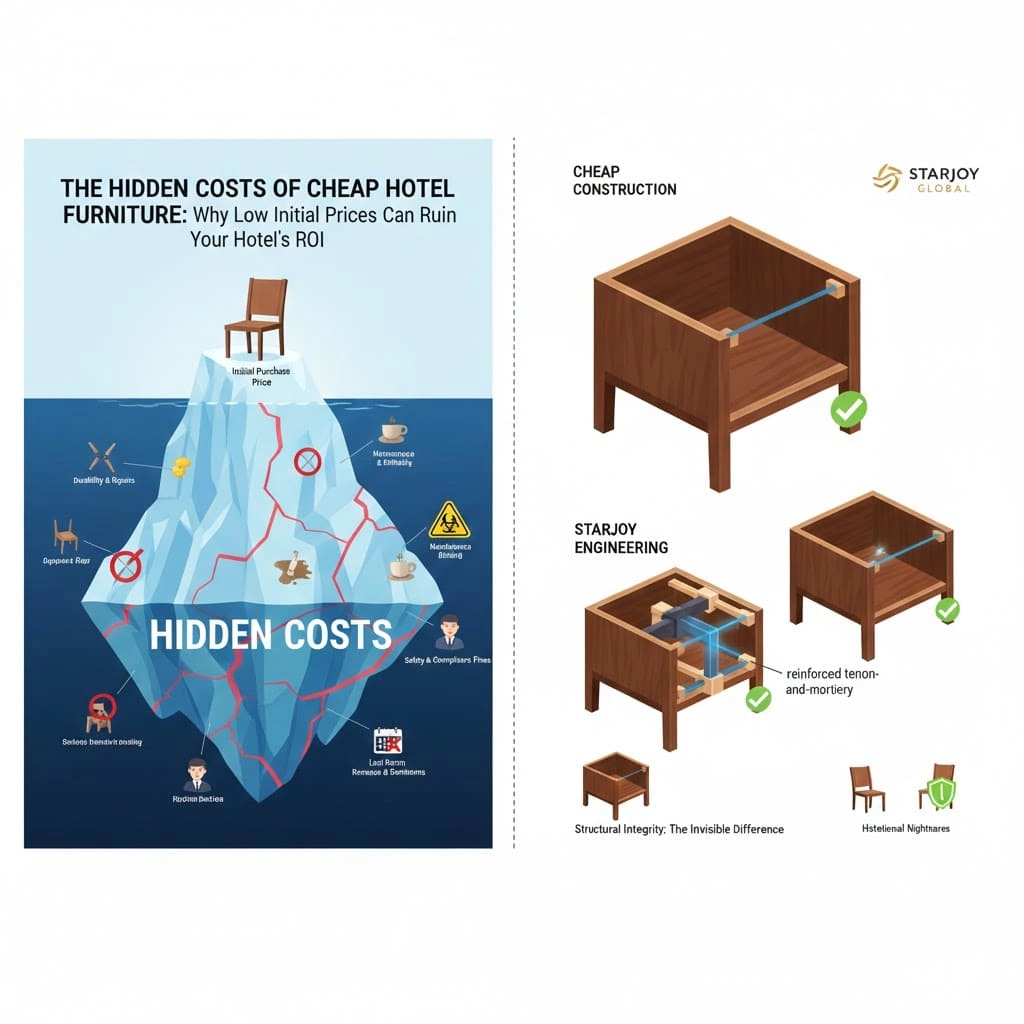
The Hidden Costs of Cheap Hotel Furniture: Why Low Initial Prices Can Ruin Your Hotel’s ROI
Why Choose STARJOY
What sets Starjoy Hotel Furniture apart from other suppliers?
Starjoy stands out due to our long history of nearly 20 years in the industry. Our expertise spans research, design, manufacturing, and installation. We also focus on providing one-stop solutions, which include personalized design, production, timely delivery, and professional installation.
Our furniture is built using advanced machinery and high-quality materials, ensuring that all products meet the highest standards of durability and functionality. We also offer customized solutions based on our clients' needs and hotel themes.
Why choose STARJOY?
1) We have perfect hotel furniture project implementation capabilities: we have a professional in-depth design team, an efficient production team, and an experienced and friendly after-sale service team.
2) Our product quality is worthy of customer trust.
3) We have a flexible pricing system.
4) We have a strong willingness to cooperate.
About Products and Services
What types of hotel furniture do you provide?
We provide a wide range of hotel furniture product, including hotel public area furniture (lobby, restaurant, conference room, etc.), guest room furniture and outdoor furniture, etc.
Are your products expensive?
We will select the most suitable materials and processes according to customer need, and meet the specific requirement of customers in a relatively economical way.
Who will bear the freight and tariffs?
Freight is usually borne by the buyer, and the specific cost will be calculated based on factor such as the volume of the goods, transportation method and distance. Taxes such as tariffs and value-added tax are determined according to the import policy of the destination country, and the buyer needs to understand and pay them by himself.
Get in Touch
We strive to provide the most thoughtful service, excellent quality and value to every customer who customizes hotel furniture from STARJOY. If you have any questions about your order, please contact us.

No.19, Gulou Industrial Zone, Jianggao Town, Baiyun District, Guangzhou
monica@starjoyglobal.com


